When a client says, “I’m thinking about selling my investment property,” they may already be doing the math: What is the property worth? What will the mortgage payoff be? How much cash will I walk away with? For a longtime landlord, there may also be some relief at the prospect of leaving tenants, repairs, and property management behind.
The decision to sell is only the start of the conversation. A significant piece of the client’s balance sheet is about to change form, potentially affecting taxes, income, debt, portfolio construction, and the estate plan. Exploring these issues before the sale can help the advisor tie the planning implications back to the client’s broader goals.
If the property has appreciated significantly, a 1031 exchange may be one option worth evaluating.
Timing matters. The exchange must be structured before the client receives the sale proceeds, and once the property closes, the client has only 45 days to identify potential replacement properties. That puts added importance on understanding what the client wants the sale to accomplish.
Before the property hits the market, seven questions can help advisors frame this critical planning conversation.
1. Why Sell the Property?
The first question is what’s driving the sale. Understanding that motivation can help clarify what the client wants the proceeds and the next stage of their financial plan to accomplish.
The reason may be:
- Less active management: After many years of ownership, the client may be ready for a more passive approach to real estate.
- Diversification: One building may have grown to represent a significant share of the client’s net worth.
- Retirement: A change in life stage may alter the role the property needs to play in the financial plan.
- An attractive offer: Sometimes the catalyst is simply a buyer willing to pay a compelling price.
From there, the conversation can turn to what the client wants the capital to do. They may want to keep generating income, maintain real estate exposure through a more hands-off structure, broaden their portfolio, create more liquidity, or put the proceeds toward another financial goal.
Understanding why the client wants to sell can help inform the bigger decision.
2. How Much Will Be Left After the Sale?
Property owners may initially think about a sale in simple terms:
Sale price – mortgage = proceeds available to invest
But the mortgage payoff is only one piece of what determines how much of the sale proceeds the client ultimately has available for their next move.
An appreciated property may carry capital gains, depreciation recapture, state taxes and, depending on the investor’s circumstances, net investment income tax. Transaction costs can further affect what remains.
Example: What a Taxable Sale Could Mean
A simplified example shows how taxes can affect the amount available to reinvest:
$2.0M sale − $60,000 closing − $439,720 tax = $1,500,280
| Sale | |
| Market value | $2,000,000 |
| Closing costs (3%) | $60,000 |
| Loan payoff | $0 |
| Net sales proceeds | $1,940,000 |
| Gain | |
| Original purchase price | $1,000,000 |
| Depreciation | $500,000 |
| Net adjusted basis | $500,000 |
| Capital gains | $1,440,000 |
| Potential tax liabilities | |
| Depreciation recapture (25%) | $125,000 |
| Long-term capital gain (20%) | $188,000 |
| State income tax (5%) | $72,000 |
| Net investment income tax (3.8%) | $54,720 |
| Total (31%) | $439,720 |
| Net proceeds to reinvest without a 1031 | $1,500,280 |
What Changes With a 1031 Exchange?
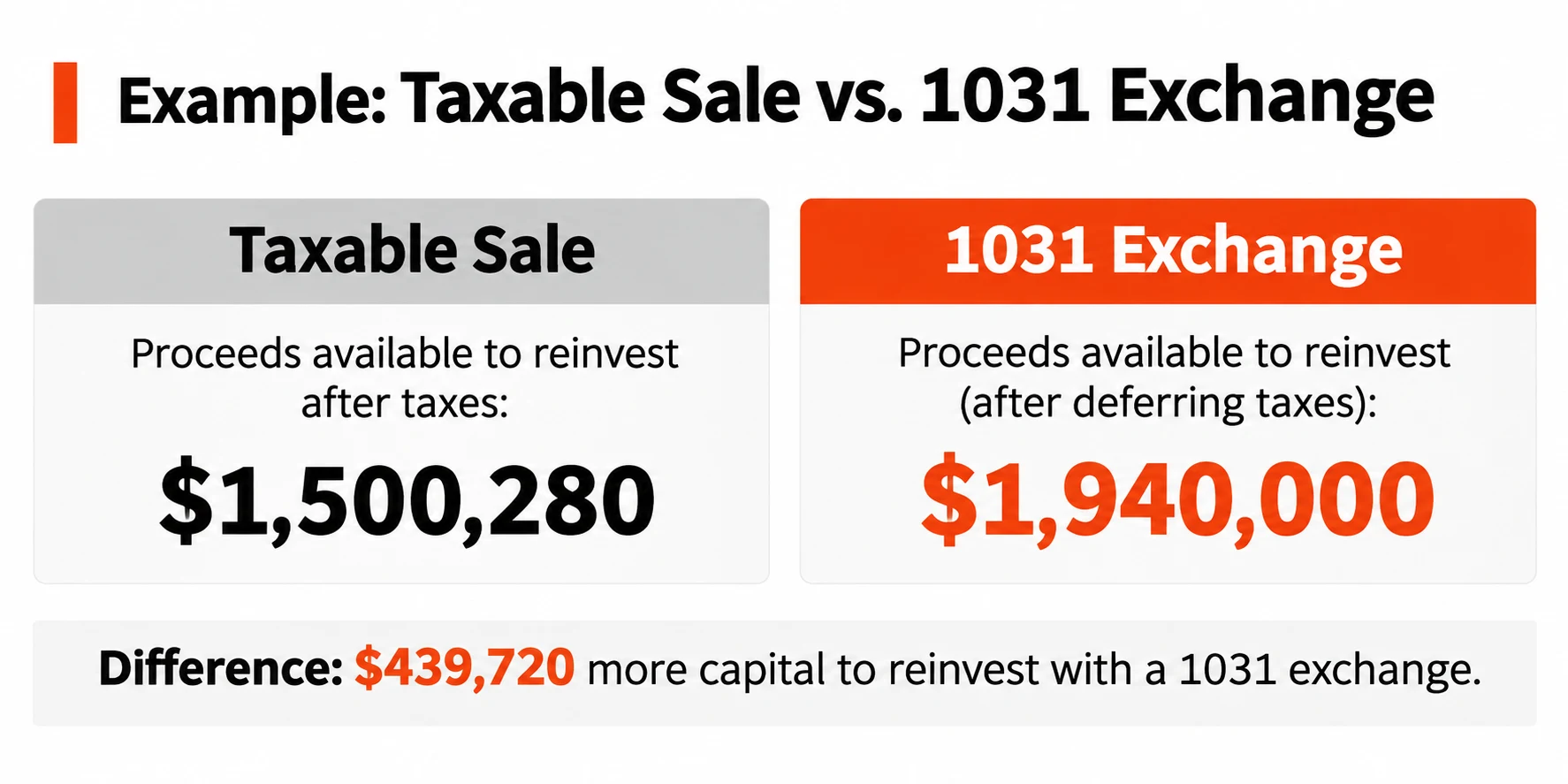
In this example, a taxable sale leaves the property owner with approximately $1.5 million to reinvest after estimated taxes. By contrast, a properly structured 1031 exchange could allow the owner to defer those taxes and reinvest approximately $1.94 million in qualifying replacement real estate.
That’s a difference of nearly $440,000 in capital potentially available for reinvestment.
A 1031 exchange does not eliminate the tax liability; it generally defers it until a subsequent taxable disposition. The exchange must also satisfy specific requirements, and the replacement property needs to align with the client’s broader financial objectives.
By identifying potential tax exposure early, the advisor can help bring the client’s tax professionals into the conversation while there is still time to evaluate how the sale fits into the broader plan.
3. What Happens to the Income?
A rental property is more than an asset with a market value. For many clients, it is also an income-producing part of the financial plan.
That income may have supported the client’s lifestyle, savings, or retirement plan for years. Looking at the property’s actual cash flow can help put its role in context. After mortgage payments, property taxes, insurance, repairs and maintenance, periods without rental income, and capital expenditures, how much is the property really contributing to the client’s financial plan — and how important is that income to them?
This can be particularly important for a landlord approaching retirement. One client may be comfortable trading some income for a more passive investment. Another may want the capital from the sale to continue producing a comparable level of cash flow.
The sale turns an income-producing asset into capital that now needs a new role in the client’s financial plan.
Have Questions?
Talk with Managing Partner Matthew Selman about your 1031 exchange.
4. What Happens to the Debt?
The mortgage payoff also plays a role in what happens next.
Consider a property selling for $1.5 million with a $600,000 mortgage. Once the loan is paid off, the owner may think of the transaction as producing $900,000 to reinvest.
If the client pursues a 1031 exchange, however, the debt matters too. For full deferral, the client generally must reinvest all net proceeds and acquire replacement property of equal or greater value; debt relieved in the sale generally must also be replaced with new debt or additional cash.
By identifying the client’s leverage early, the advisor can help make sure debt is part of the conversation as the client’s tax and exchange professionals evaluate the transaction.
For a leveraged owner, equity is only part of the replacement-property equation.
5. What Role Should Real Estate Play Going Forward?
Once the financial implications of the sale are clearer, the conversation can shift to what the client wants their relationship with real estate to look like going forward.
That could mean:
- Continuing with direct ownership through another investment property.
- Taking a more passive approach to real estate ownership.
- Diversifying across property types, markets or multiple properties.
- Reducing real estate exposure and putting some or all of the capital to work elsewhere.
Where the client wants to go from here should drive the planning conversation. Tax considerations are part of that decision, along with income needs, liquidity, diversification, and how involved the client wants to be in managing real estate.
For clients who want to maintain real estate exposure through a more passive ownership structure, a Delaware Statutory Trust (DST) may be one option to consider. A properly structured DST can qualify as 1031 replacement property while providing fractional ownership in professionally managed real estate. The tradeoffs are different from direct ownership, including liquidity, control, fees, and property-level risk.
A DST can fit within a 1031 exchange because a properly structured DST interest is treated as an interest in the underlying real property for federal tax purposes. And “like-kind” does not mean the replacement property must be identical to the property sold: qualifying investment real estate may generally be exchanged for other qualifying investment real estate. Depending on the circumstances, that can mean a different property type, market or ownership structure.
Start with what the client wants their real estate investment to accomplish, then evaluate which ownership approach best supports it.
6. How Does the Sale Fit Into the Estate Plan?
For long-term real estate owners, the decision about what comes after the sale may eventually affect more than the current owner. The advisor can help the client consider how today’s real estate decisions fit with the broader estate plan — including what the client expects heirs to inherit and how easily those assets can be managed or divided.
A property that works well for one owner may become more complicated when it passes to several heirs. Three children inheriting equal interests in an apartment building, for example, also inherit decisions about management, expenses, future improvements and when — or if — to sell. If simplifying the transfer of wealth is important to the client, that may influence what they choose to own next and how they choose to own it.
Taxes are part of that conversation as well. Under current law, property acquired from a decedent generally receives a basis adjustment under IRC Section 1014 based on fair market value at death. For an investor who has deferred gain through 1031 exchanges, this basis adjustment may reduce or eliminate the deferred gain for heirs, depending on the facts and rules in effect at the time.
By connecting the client’s real estate decisions with the estate plan, the advisor can help make sure the next investment supports both how the client wants to own wealth today and how they ultimately want to transfer it.
7. Does a 1031 Exchange Make Sense?
By this point, the complete picture of the client’s goals should be clear. The conversation has moved beyond the property itself to the client’s tax exposure, income needs, use of debt, desired real estate exposure, and estate objectives.
With those goals defined, the advisor and the client’s tax, legal and exchange professionals can evaluate whether a 1031 exchange fits the plan. An exchange may allow the client to defer current taxes and keep more capital invested in real estate, but the replacement property still needs to fit the client’s income, liquidity, risk, management and estate-planning objectives.
Depending on those objectives, the replacement property might be another directly owned asset or, for an appropriate investor seeking a more passive approach, a structure such as a DST.
Once a 1031 exchange appears to support the client’s objectives, timing becomes part of the planning. A Qualified Intermediary (QI) needs to be in place before the relinquished property closes, and the client cannot take actual or constructive receipt of the exchange proceeds. From the sale date, the exchange moves quickly:
- Day 0: The relinquished property closes and exchange proceeds are directed to the QI.
- Day 45: Replacement properties must be identified.
- Day 180: The replacement property must be acquired.
For full deferral, the transaction needs to account for the amount reinvested, the value of the replacement property, and any debt relieved in the sale.
That brings the advisor back to the value of starting the conversation before the property is sold.
Deciding what the client wants the sale — and the next investment — to accomplish is better done before the clock starts.
Recognize the Planning Event Before the Closing
When a client says, “I’m thinking about selling the building,” the advisor has an opportunity to broaden the conversation beyond the sale itself. Starting that conversation early can help clarify what the client wants the sale to accomplish and bring the appropriate tax, legal, exchange, and real estate professionals into the planning process. From there, a 1031 exchange — and potentially a DST — can be evaluated against the client’s broader objectives and what they want the capital to accomplish next.